A World Bankrupt of Water
Bob Sandford
The Rocky Mountain Outlook, January 2026

Flagship report calls for fundamental reset of global water agenda as irreversible damage pushes many basins beyond recovery
There is promising news on the climate action front regarding how quickly energy provided by the sun and the wind have transcended all expectations with respect to cost and are, in some places, like China and India, not only meeting existing local energy needs but also absorbing increased demand. If the scaling up of renewables continues at this rate, there is a slim but real hope that the world could, provided we avoid war, reach net-zero by mid-century.
Unfortunately, this good news is overshadowed at the moment by our failure to act on an earlier global problem while it would have been possible to do so. While we have been intentionally distracted by a tsunami of manufactured geopolitical tensions, the global water crisis, which has been creeping steadily forward for decades, has continued in its silent advance and has now become a more immediate threat to our future than even the accelerated warming of our climate to which it is joined at the hip.
We find ourselves now confronted with a reckoning with respect to global water security. Nature, our forgiving banker, was patient with us as we continually failed to make the promised repayment installments which were to take the form of forest, watershed and biodiversity protection, protecting rivers and groundwater sources, maintaining climate stability, and staying within other known safe Earth system boundaries.
Now the moment of truth we knew had to come has arrived. Our much-vaunted belief that we were too big to fail has proven to be a self-deception, an utter myth. Our biodiversity-based planetary life-support system is no longer able to increase our credit limit without facing bankruptcy itself. Nature has initiated foreclosure proceedings which will begin with shutting off the water.
The loss of our glaciers and diminishment of snow and ice globally are just the start. The water is slowly being shut off. What’s next? Unless we can miraculously come up with what we owe Nature, it is clear that eviction is next, and that is something the UN is doing everything within its powers to avoid.
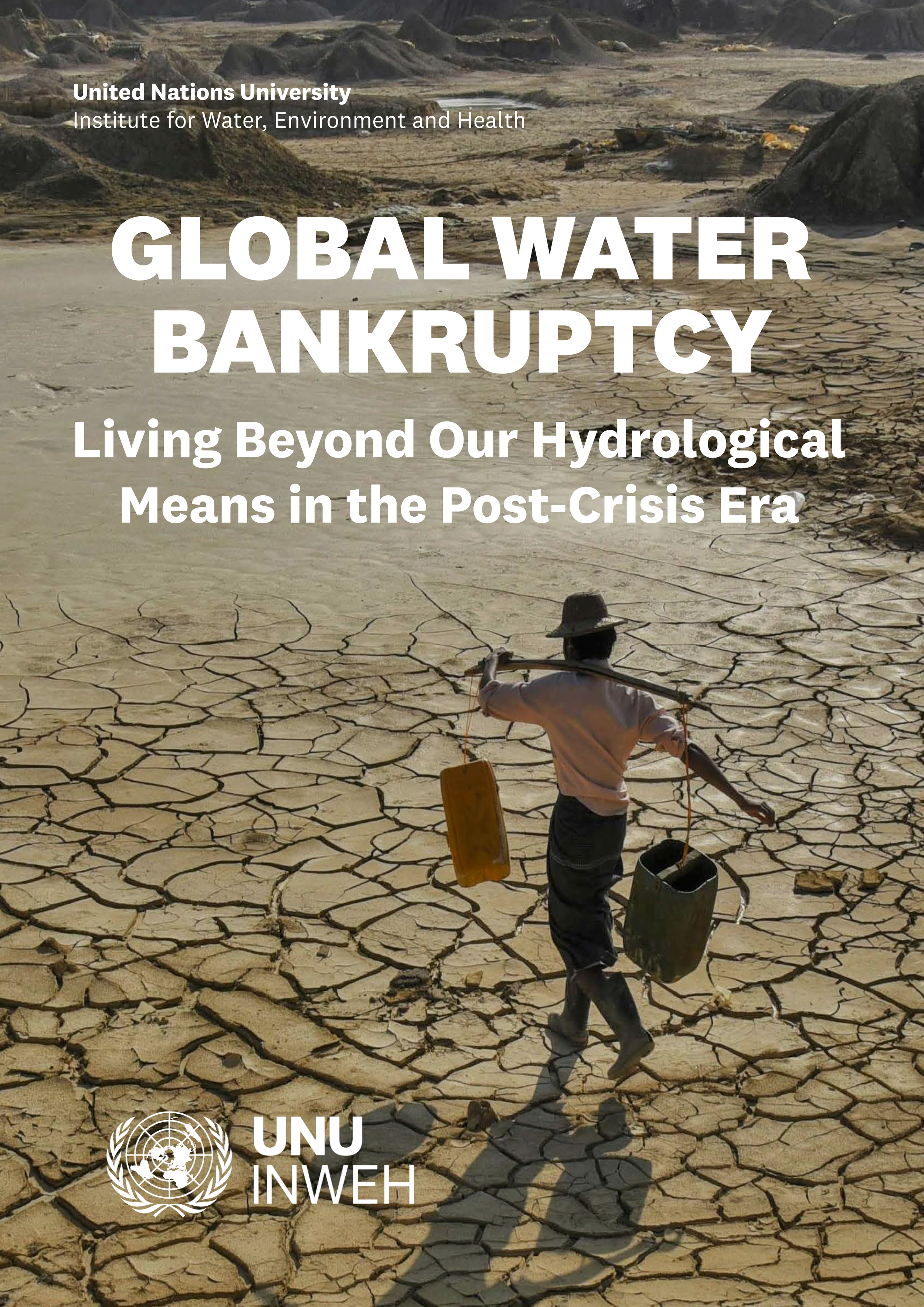
The main premise of our institute’s Global Water Bankruptcy: Living Beyond Our Hydrological Means in the Post-Crisis Era report, which was released by the UN in New York on Jan. 20, is that we need to realize that we have reached the stage now with respect to water security globally that we need to name and admit failure so that we can enable positive change.
The UN report proposes water bankruptcy as a formal name for this post-crisis state, defined by a persistent over-withdrawal relative to renewable inflows and safe levels of depletion; and
the resulting irreversible or prohibitively costly loss of water-related natural capital that is the source of all water wealth.
The report clearly shows that even nations like Canada, or regions within water-rich countries that consider themselves water sufficient, are not immune to water bankruptcy.
Water bankruptcy occurs when the natural capital that provides the liquid income provided by snow cover and snowpack, melting glaciers, reliable rainfall, wetlands and groundwater that becomes water in the bank gradually dries up.
This global report puts into clear relief how close to water bankruptcy places like southern Alberta have become. The report points out that the sure sign of pending water bankruptcy is the lock-in of maladaptive infrastructure when jurisdictions respond to perceived or real crises by building more dams, drilling deeper wells, or begin diverting rivers—options that can temporarily mask scarcity but deepen long-term insolvency.
The biggest strategic mistake in bankruptcy, whether financial or hydrological, is refusing to acknowledge insolvency. If Alberta is to avoid water bankruptcy, it has to admit defeat—honestly and early. Alberta must act now to protect remaining natural capital as the core asset that must not be sacrificed for marginal or short-term gain. It must be accepted that each additional centimeter of drained wetland or mined headwater represents a loss of resilience that no engineering project can fully replace.
In officially recognizing the necessity and urgency of bankruptcy allocation, Alberta must establish transparent, fair and principled rules for sharing scarcity and combine them with participatory processes and strong social safety nets that can prevent bankruptcy management from becoming a technocratic justification for dispossession.
The UN Global Water Bankruptcy report is a warning. Our climate is going to continue to warm with unthinkable impacts on mountain snowpacks and on glacial headwaters. Imagine the Bow River with a flow half of what it is now and you get the picture of what water bankruptcy would mean to us and to everyone downstream - and understand why we need to manage our water far differently than we do, now and in the future.
Global Water Bankruptcy
The report makes the case for a fundamental shift in the global water agenda—from repeatedly reacting to emergencies to “bankruptcy management.” That means confronting overshoot with transparent water accounting, enforceable limits, and protection of the water-related natural capital that produces and stores water—aquifers, wetlands, soils, rivers, and glaciers—while ensuring transitions are explicitly equity-oriented and protect vulnerable communities and livelihoods.
Crucially, the report frames water not only as a growing source of risk, but also as a strategic opportunity in a fragmented world. It argues that serious investment in water can unlock progress across climate, biodiversity, land, food, and health, and serve as a practical platform for cooperation within and between societies. Acting early, before stress hardens into irreversible loss, can reduce shared risks, strengthen resilience, and rebuild trust through tangible results.